The child who couldn't sit still around chaos
I started my first business before I was eight years old, selling bitter leaf and oranges.
My father discouraged it. He worried business would distract me from school. But even then, something in me couldn't sit still around chaos. I was the child who wouldn't rest until everywhere was organised: my father's cupboard, his bookshelves, the space under his table, my own room. I'd tidy my mother's room even when she wasn't happy about her things being moved.
That instinct never stayed in the house. At church, I left the choir to revive an ushering department that was down to one brother and a handful of people who came and went as they pleased. I took a foundation school department that was casual and barely there, and built it into something that graduated with the discipline of a college. Structure has always been the thing I couldn't walk past without fixing.
Most of what looks like talent is actually structure.
Building it properly
Around twenty, I built a hair business in Nigeria that I refused to run like every other hair-selling hustle. Before I ordered a single bundle, I chose a name I could register, brand and one day take global. And I did: CAC registration, a proper logo, a real launch. It thrived, until a major change in my life and the relocation that came with it forced me to pause it.
What didn't pause was the structure. I joined a company as a customer service staff member and was promoted to Head of Operations within my first three months, managing two branches in Lagos and Abuja. I couldn't leave things the way I found them: service cards, company policies, employee handbooks, proper employment letters, reporting systems and structured staff training. I ran the trainings myself, represented the company locally and internationally, and closed 11 institutional partnership deals, including the New York Film Academy.
Find the chaos. Build the structure.
Along the way I earned a BSc in Finance & Banking in Nigeria, at Niger Delta University, and an MSc in Project Management in the United Kingdom, at the University of Bedfordshire, on a scholarship I wasn't even supposed to qualify for. PRINCE2 and Scrum certifications followed, along with 7+ years of operations and strategy leadership across Nigeria, Ghana and the UK.
I've watched this shift change lives up close. A neighbour of mine in Ghana used to cook from home and sell every now and then. Today she runs a fully automated delivery business that serves customers around the clock, without burning herself out, because we built the structure underneath the hustle she already had.
A bigger question
Somewhere along the way, I stopped thinking of myself as someone who just keeps the trains running. I started asking a bigger question. What if the structure I was building inside companies could be handed to the people and organisations that usually get left behind?
What if access to opportunity, to income, and to the tools AI is quietly redistributing right now didn't depend on where you were born or who you already knew?
That question is the reason the work I do today exists. Through my consulting practice, I help businesses, organisations and churches build clearer systems and use AI practically. Through Purpose & Profit, I share what it means to rebuild with God and scale with strategy. And through AfriTech Hub, I'm opening the door to practical AI and digital skills for anyone ready to walk through it.
The hidden season
None of this came easily, and I won't pretend it did. At the end of 2025 I relocated from Ghana back to Nigeria, and the January that followed was one of the hardest months I have lived through.
For a season, I went quiet. I shut down a WhatsApp line holding years of contacts and relationships, stepped back from the noise, and gave myself a deliberate, hidden season to rebuild. Not just my business, but my habits, my focus and my own belief in what I was building.
The framework that came out of that season is what I call Project 90: break the old patterns, build the new ones, and become the person the work actually needs you to be. I'm still living inside that framework today, because growth that is real never really finishes.
Why I keep showing up
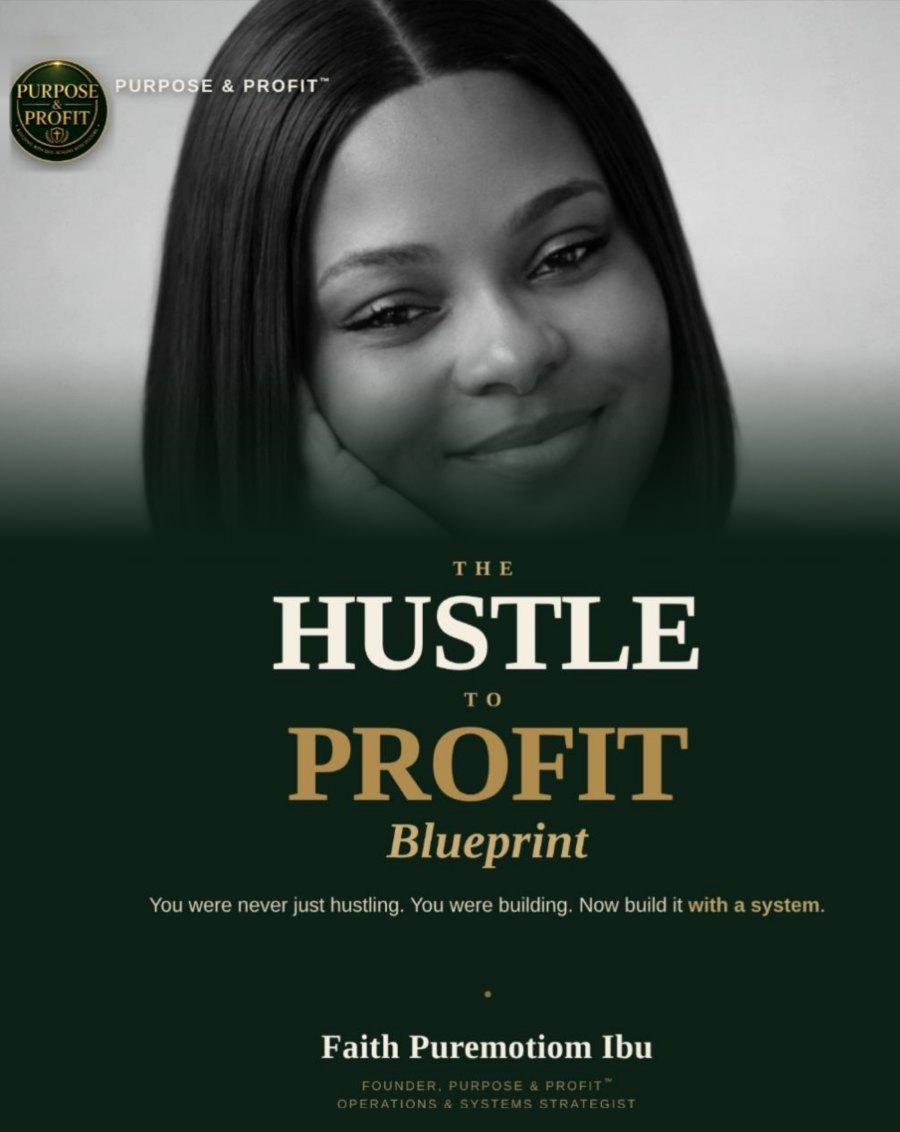
I wrote The Hustle to Profit Blueprint to put that same thinking in the hands of anyone trying to build something real without a safety net beneath them. It was almost a year and a half in the making. I could have used AI to build it in a weekend. I chose not to, because excellence doesn't take shortcuts with something meant to change someone's life.
I know Nigerians work hard. Africans work hard. This isn't about working harder. It's about translating that hard work into smart work, so it finally builds something that lasts. My belief is simple: you can make profit while discovering and fulfilling your purpose.
So I keep showing up in boardrooms, in church youth halls, on stages, and in WhatsApp groups at midnight answering one more question. I believe the biggest gap in Africa right now is not talent. It is access. Access to structure. Access to opportunity. Access to the tools already changing who gets to win next.
I intend to keep closing that gap, one system, one pathway, one person at a time.

Faith Puremotiom Ibu | Faith Boundless | Purpose & Profit